The fundamentals, done properly: auto attendant and multi-level IVR, ring groups, hunt lists, time conditions and holiday routing, call parking and pickup, paging and intercom, busy lamp fields, call recording with pause and resume, call flip between devices mid-conversation, voicemail to email, and the feature codes and function keys an engineer expects to find. Music on hold streams from a playlist rather than a single looping file, and custom prompts can be uploaded per customer. All included in the Standard plan.
The PSTN switch-off completes in January 2027, and every ISDN and analogue line in the UK has to go somewhere before then.
The P-Series Appliance keeps the analogue and ISDN estate working on modular cards while the calls move to our AI Powered SIP Trunks — or put the customer on P-Series Cloud instead.
What Is the P-Series Appliance?
It is the same P-Series phone system as the cloud version, but supplied as a physical appliance that sits in the customer’s comms room. Calling, Linkus apps, video, queues, messaging, reporting and integrations all run locally on the box rather than in a remote data centre.
That also means a broadband outage does not take the phone system itself offline. Internal calls continue to work and, where the system has been designed with an FXO line or 3G/4G module, outbound calls can continue as well.
The main difference between the appliance and simply running the software on a server is the built-in telephony hardware. The interfaces are modular, so each system can be specified with the analogue, ISDN or mobile connectivity needed at that particular site. It can connect directly to services the customer already has, without having to add separate gateways alongside the PBX.
Why Partners Sell It
There are still plenty of customers who simply do not want their phone system hosted in somebody else’s data centre. For those businesses, an on-premise P-Series appliance gives you a straightforward alternative without having to move away from the Yeastar platform.
It can also be a strong commercial sale. The Standard plan is included with the appliance, so the customer buys the system outright and has a fully functioning phone system from day one, rather than committing to another monthly subscription. For the reseller, that means useful upfront hardware margin as well as the ongoing revenue from SIP trunks, connectivity, support and any additional services around it.
Just as importantly, it keeps you competitive in sites where a cloud-only proposition can be difficult to make work. That might be a customer with a large analogue estate, a building where connectivity is limited or awkward, or an organisation that wants call recordings and other data kept on site for operational or compliance reasons.
When On-Premises Wins the Deal
Cloud is the right answer for most businesses most of the time, and we will say so. But there are four situations where an appliance is not a compromise — it is the only sensible answer, and knowing them is how you stop losing those sites to somebody who stocks hardware.
The Data Has to Stay Put
Legal, healthcare, financial services, defence suppliers and a surprising number of local authorities have rules — or a compliance officer with strong opinions — about where call recordings and call data may sit. On an appliance the answer is simple: in that cabinet, in that building, on that disk.
It is an argument you can win in one sentence, and it is very hard to win any other way once somebody has decided the recordings are not leaving the premises.
There Is a Lot of Analogue
Door entry panels, lift phones, fire panels, fax lines for a laboratory, a paging system over a warehouse, an intercom on a loading bay. None of it is going away before January 2027 and none of it speaks SIP.
FXS and FXO cards slot into the appliance itself, so those devices terminate on the phone system rather than on a stack of small gateways that each need their own power, IP address and firmware policy. One box, one support contract, one thing to fail over.
The Internet Is Not Reliable
A quarry, a farm shop, a rural hotel, a factory at the end of a very long copper run. When the circuit drops on a hosted system every phone in the building goes with it. When it drops on an appliance, internal calls carry on as though nothing happened.
Add a 3G/4G module or keep a couple of analogue lines on FXO ports and outbound calls survive the outage too. Where the connectivity is the problem rather than the platform, our SoGEA, FTTP and leased line options are worth quoting alongside.
They Would Rather Buy It
Some finance directors want capital expenditure and an asset on the balance sheet, not another monthly line item. Some customers have a grant, a budget that expires, or a leasing arrangement that only works against hardware.
That is a preference worth serving rather than arguing with. It also front-loads your margin: the box, the modules, the handsets and the install are all billed at the start, and the plan renewal, the trunks and the support contract follow behind it.
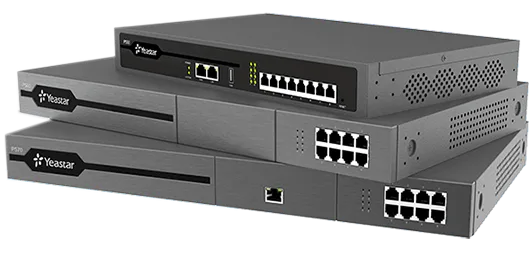
Four Models, One Platform
Every appliance runs the same software and looks the same to the person using it. What changes between them is how many people it holds, how many of them can be on a call at once, and how much can be plugged into the front.
| Specification | P520 | P550 | P560 | P570 |
|---|---|---|---|---|
| Users | 20 | 50 | 100 / 200 | 300 / 500 |
| Concurrent calls | 10 | 25 | 30 / 60 | 60 / 120 |
| FXS ports (analogue devices) | 4 | 8 | 8 | 16 |
| FXO / BRI ports (lines, ISDN) | 4 | 8 | 8 | 16 |
| 3G / 4G ports | 1 | 4 | 4 | 6 |
| ISDN30 / PRI ports | — | — | 1 | 2 |
| Expansion boards | — | — | 1 | 2 |
| DSP capacity modules | — | — | 1 | 2 |
Figures shown as “base / licensed” are the shipped capacity followed by the maximum reachable with DSP capacity modules and user licences. Port counts are maximums with the chassis and expansion boards fully populated.
Two things are worth knowing before you quote. The first is that only the P560 and P570 take expansion boards, so a site that will eventually need ISDN30 or more than eight analogue ports starts at a P560 whether or not the headcount says so. The second is that concurrent calls, not users, is the number that gets sites into trouble — a fifty-seat contact centre and a fifty-seat solicitor’s office are very different loads.
If you would rather not size it alone, send us the site survey. Pre-sales is part of what you get from us, and getting the model and the module list right first time is considerably cheaper than getting it wrong. The full P-Series Appliance datasheet has the detailed specifications.
Modular by Design
Most on-premises phone systems make you choose the interface mix at the point of purchase and live with it. The P-Series does not: the telephony interfaces are cards, and the cards come out.
A site that needs four analogue extensions today and an ISDN circuit next year does not need a different appliance next year. It needs another card.
That changes the conversation from “buy for the worst case” to “buy for now” — an easier order to get signed, and a reason for the customer to come back to you when the site grows rather than going out to tender for a replacement system.
Keep the Old Kit
Analogue handsets, door entry panels, lift phones, fax machines and the paging amplifier over the warehouse all connect to the appliance directly, on FXS ports (S2 card). Analogue lines the customer is keeping — including the one the alarm company insists on — land on FXO ports (O2 card), and there is a hybrid with one of each (SO card) for the small sites that need a bit of both.
An ISDN2 circuit that has not been migrated yet goes on a B2 card. Nothing needs a separate gateway, so there is one box to power, patch and support rather than a shelf of them.
Add a Way Off Site
A 3G/4G module puts a mobile SIM into the dial plan. On a site with poor or unreliable broadband it is the difference between a phone system that can still call out during an outage and one that cannot, and it costs a card rather than a second circuit.
It earns its place commercially too: on rural sites, and on anything with a lift, a fire panel or a lone worker to think about, being able to promise calls still get out is often what wins the job.
Room to Grow
More people? A DSP capacity module adds 100 users and 30 concurrent calls — one on a P560, up to two on a P570. More things to plug in? An EX08 board adds four more card slots, and an EX30 board adds an ISDN30 / PRI port for a site still running a 30-channel circuit.
The P560 takes one expansion board and the P570 takes two; the P520 and P550 use the chassis slots only. Worth raising at the quote stage, because it makes the customer’s growth a reason to buy rather than a reason to hesitate.
Inside the Platform
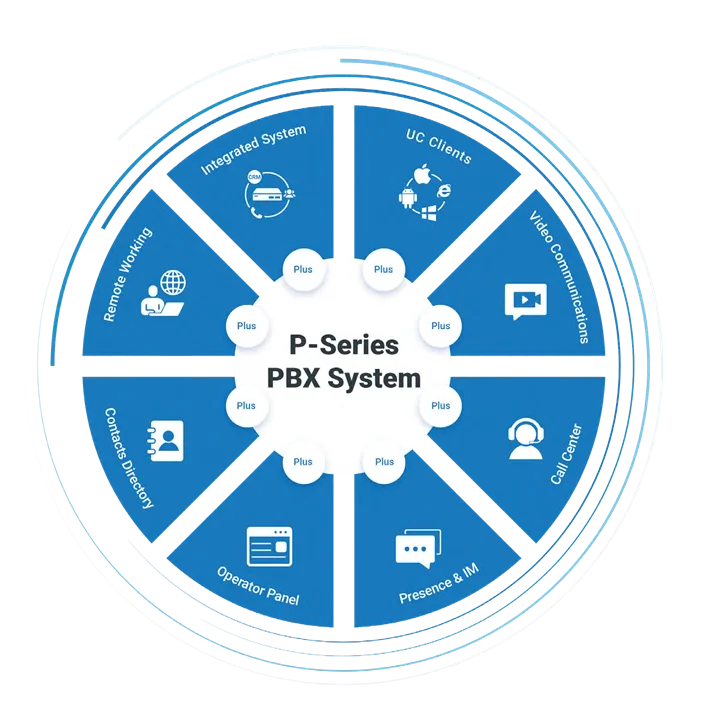
Buying the hardware does not mean buying a lesser phone system. The appliance runs the same P-Series software as the cloud edition, configured from the same web interface, with the higher-end capabilities sitting on the Enterprise and Ultimate plan tiers rather than being separate products.
The Standard plan comes with the appliance. What a customer actually needs is usually obvious after ten minutes on site — ask us and we will tell you which tier covers it.
One extension across a web browser, a Windows or Mac desktop app, an iOS or Android phone, and a Chrome extension that adds click-to-dial to any web page. Presence, custom status messages, company and personal directories, call history, team chat and file sharing follow the user between them, and a live call can be moved from a desk phone to a mobile without dropping. Linkus is included on every plan, which removes the usual argument about who is worth a licence.
Video calling and video conferencing run in the same client as the phone, so a call can become a meeting without moving to another product. Screen sharing and guest access are built in, and a door phone’s camera can be previewed from the client before anyone is let in. Video sits on the Ultimate tier — worth checking before you quote a customer who has assumed it is included everywhere.
Queues with skills-based and priority routing, queue callback so a caller keeps their place without holding, live wallboards on the office screen, an operator panel that shows call flows in real time and dispatches calls by drag and drop, whisper, barge and listen for coaching, SLA thresholds and agent reports. The reporting that goes with it is in the platform, not a separate analytics purchase. Contact centre features sit on the Enterprise tier and above.
SMS, WhatsApp, Facebook Messenger and website live chat land in the same inbox as the calls, assigned to agents the same way, with the whole history kept against the contact. For a lot of customers this is the reason to move rather than the reason to stay: their clients stopped ringing years ago and started messaging. Enterprise tier and above.
Yeastar integrates with Microsoft Teams so users can make and receive external calls from inside the Teams client they already live in, without Microsoft calling plans. Alongside it, Microsoft 365 and Outlook keep contacts and calendars in step, and Microsoft Entra ID (formerly Azure AD) handles user provisioning and single sign-on. Google Workspace, LDAP and Windows Active Directory are supported too. Enterprise tier and above — and see our solutions page for the wider Teams options we can put in front of a customer.
Salesforce, HubSpot, Microsoft Dynamics 365, Zoho, Odoo and Bitrix24 on the CRM side; Zendesk and Zoho Desk on the helpdesk side. Click to call from the record, screen pop on an inbound call so the person answering already knows who it is, automatic call logging, and contact creation for numbers nobody recognises. Where a customer runs something bespoke there is an open API, a call control and event notification API, uaCSTA and a TAPI driver to build against. Enterprise tier and above.
Call detail records with custom reports, call accounting with your own rate tables for customers who cross-charge departments, and a data connector that streams call data into PostgreSQL, MySQL or Microsoft SQL with ready-made dashboard templates. Recordings and backups can be archived off the appliance automatically to FTP, SFTP, Google Storage or Amazon S3 — which is how you keep a long recording retention policy without filling the box.
The appliance is compatibility tested with 210+ SIP trunk providers, so you are not forced onto a particular carrier, and it terminates analogue lines, ISDN2 and ISDN30 directly through its own cards. Most TruSIP partners pair it with our own SIP trunks, which puts the platform, the lines and the calls on one bill behind one support number — but the choice is yours, and a customer mid-contract with somebody else can be migrated when that contract ends rather than being a reason not to sell the box.
What the Appliance Does Not Have
Worth knowing before you promise it. The AI Receptionist, live call transcription and automatic call summaries are features of the P-Series Cloud and Software Editions and are not available on the Appliance Edition. If a customer wants those, the options are to put them on P-Series Cloud instead, or to apply AI at the trunk with our AI Powered SIP Trunks so it covers every call regardless of which phone system answers it. Voicemail transcription is available on the appliance on the Ultimate tier.
Resilience and Security
The objection to on-premises is always the same: what happens when the box dies, and who is responsible when somebody dials Vanuatu at four in the morning. Both have answers, and both are worth walking a customer through rather than leaving on a datasheet.
Hot Standby
Two identical appliances on the same LAN behind a shared virtual IP, replicating in real time. The standby heartbeats the active unit and takes over automatically if it stops — typically in one to ten seconds. Phones and integrations follow the virtual IP, so nothing has to be repointed.
Toll Fraud Defence
A global anti-hacking IP blocklist, automatic and static intrusion defence, country and code allow-lists, and outbound call frequency limits. Toll fraud is the incident that ends reseller relationships, so these are worth configuring properly on day one rather than after the first bill.
Encryption and Access
SRTP and TLS call encryption, two-factor authentication on the management interface, an enforceable password policy and managed certificates. Yeastar is GDPR compliant and holds ISO 27001, ISO 9001 and ISO 14001 certification, which answers most of a procurement questionnaire before it is asked.
Remote Management
Yeastar Central Management connects on-premises appliances over an HTTPS-secured link for monitoring, configuration and provisioning, so you see the health of every customer site from one console. Most faults get fixed without anyone getting in a van. Runs on the Remote Management Premium service.
Survives the Circuit
Internal calling, voicemail, the auto attendant and internal routing all run on the appliance, so a broadband outage does not silence the building. Keep an FXO line or a 3G/4G module in the design and outbound calling survives it too.
Backups and Archiving
Scheduled configuration backups, and automatic archiving of recordings and backups to FTP, SFTP, Google Storage or Amazon S3. A long retention policy stops being a storage problem, and a replacement appliance can be restored to the last known-good configuration.
What You Get From TruSIP
Yeastar builds the hardware. What you buy from us is the hardware plus the things that make it sellable — and a UK team in Manchester who will answer the phone when a deployment does not go to plan.
Sizing That Is Right First Time
Send us the site survey and we will tell you the model, the module list and the plan tier. Getting it right first time costs a phone call; getting it wrong costs a return and a rebuild.
Your Brand, Not Ours
We are channel-only and never approach your customer. The relationship, the contract and the margin stay where they belong — with you.
Trunks From the Same Place
Pair the appliance with our own SIP trunks and the hardware and the calls arrive on one bill, backed by one support number.
Training That Sticks
Yeastar training for your engineers and your sales people, so the knowledge lives in your business rather than in ours.
We’ll Build It If You Want
Installation and configuration services for the deployments you would rather hand over, delivered under your name.
Billing Handled
White label billing if you would rather not build an invoicing operation to sell a phone system.
A Choice of 500+ Handsets
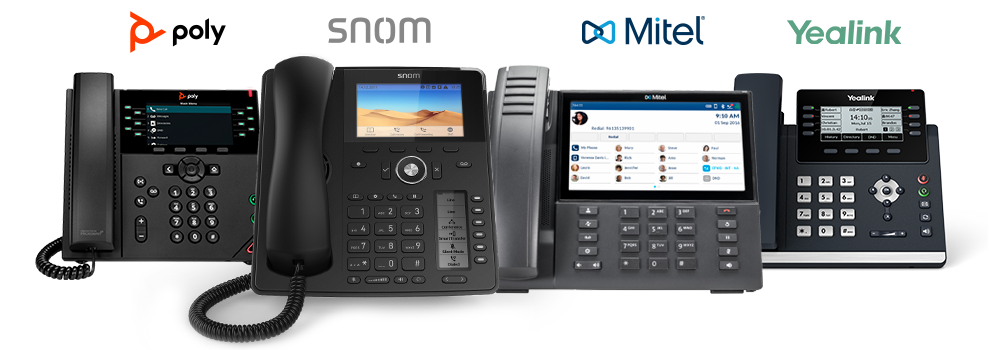
Yeastar makes your choice of phone integrate seamlessly with the P-Series Appliance. The SIP phones from the manufacturers below have been tested with the automatic provisioning features, enabling users to register, activate and configure IP phones quickly and in bulk.
That matters more than it sounds. Auto-provisioning is the difference between an engineer plugging in forty phones and forty phones plugging themselves in — the handset finds its configuration, takes its extension, picks up the customer’s directory and the right firmware, and is ready before anyone has opened a laptop. It also means a replacement phone for a broken one is a five-minute job rather than a site visit.
Several hundred handset models across the manufacturers below have been tested, from single-line desk phones to DECT systems for warehouses and executive handsets with expansion modules. If a customer already has SIP phones on the wall, there is a good chance they can keep them — and if they have analogue handsets they want to keep, those go on FXS ports rather than in a skip.
Yealink
Fanvil
Avaya
Cisco
Snom
Poly
NEC
Gigaset
Grandstream
Mitel
Huawei
V-Tech
See the full list of supported manufacturers and models on the Yeastar website.
On-Premises or Cloud?
It is the same P-Series, with the same interface and very nearly the same feature set. The question is only where it runs — and it is worth asking properly, because the answer changes the shape of the deal rather than the product.
Choose the Appliance when…
There are rules about where data may sit, or a compliance officer who wants the recordings in the building. There is a mass of analogue to keep alive — door entry, lift phones, fax lines, a paging system — and card slots are the tidy answer. The site is remote and the internet is not something anyone would describe as reliable. Or the customer’s finance director simply prefers to buy things.
Take the AI features into account as well: the AI Receptionist and live transcription are Cloud and Software Edition capabilities, so a customer who wants those on site is really a customer for P-Series Cloud, or for AI applied at the trunk instead.
Choose Cloud when…
The customer has no comms room worth the name, or several sites and no obvious place to put a box. They want a monthly cost rather than a capital purchase. They have staff working from home who are never coming back full time. They are growing, or shrinking, and would rather not guess how big to buy. Or they simply do not want to own, insure, patch and eventually replace a piece of hardware to answer the phone.
Read about Yeastar P-Series Cloud, including white-label branding, Yeastar Central Management and the AI features. Customers can move between the two later — the platform is the same either way.
Yeastar P-Series Appliance: Common Questions
The questions partners ask us most often before their first on-premises Yeastar deployment.
What is the Yeastar P-Series Appliance?
It is an on-premises business phone system: a single piece of hardware that sits in the customer’s comms room and runs the whole P-Series platform locally. Calling, Linkus apps, video, queues, messaging and reporting all run on the box itself, and the telephony interfaces are modular cards you specify to suit the site.
Which P-Series appliance model does a customer need?
Size on users and concurrent calls. The P520 covers 20 users and 10 concurrent calls, the P550 covers 50 users and 25 calls, the P560 starts at 100 users and 30 calls and licenses up to 200 users and 60 calls, and the P570 starts at 300 users and 60 calls and licenses up to 500 users and 120 calls. Only the P560 and P570 take expansion boards, so a site that will need ISDN30 or a large number of analogue ports starts at the P560 regardless of headcount. The model table above has the port counts.
Can a P-Series appliance be expanded after it is installed?
Yes. Telephony modules — S2 for two FXS ports, O2 for two FXO ports, the SO hybrid, B2 for two BRI ports, and 3G/4G modules — slot into the chassis. The P560 takes one expansion board and the P570 takes two: an EX08 board adds four module slots, an EX30 board adds an ISDN30 / PRI port. DSP capacity modules add 100 users and 30 concurrent calls each, one on the P560 and up to two on the P570.
Does the appliance support analogue, ISDN and mobile lines?
Yes, and that is usually the reason to choose it. FXS ports connect analogue devices such as door entry panels, lift phones, fax machines and paging systems; FXO ports connect analogue lines; BRI ports connect ISDN; 3G/4G modules put mobile SIMs into the dial plan; and ISDN30 is available on the P560 and P570 through an EX30 board. Alongside those, the appliance is compatibility tested with 210+ SIP trunk providers, including our own SIP trunks.
What happens if the appliance fails?
Hot Standby pairs two identical appliances on the same LAN behind a shared virtual IP, replicating data between them in real time. The standby unit sends heartbeat packets to the active one and takes over automatically if they stop, typically in one to ten seconds, with phones and integrations following the virtual IP rather than needing to be repointed. Both units must be the same model with the same modules in the same slots and the same firmware, and Yeastar does not require an additional plan subscription for the standby unit.
Can I manage a customer’s appliance remotely?
Yes. Yeastar Central Management connects on-premises P-Series appliances for remote monitoring, configuration and provisioning over an HTTPS-secured connection, so you can see the health of every customer site from one console and fix most things without travelling. Remote management of on-premises devices runs on the Remote Management Premium service.
Which plan does a customer need — Standard, Enterprise or Ultimate?
The Standard plan is included with the appliance and covers the core phone system: call routing, IVR, ring groups, recording, voicemail, the Linkus clients and basic reporting. Enterprise adds omnichannel messaging, CRM and helpdesk integration, Microsoft 365 and Teams integration, the call centre features and remote access. Ultimate adds video conferencing, voicemail transcription, the Linkus SDK and the optional hotel PMS module. Talk to us with the requirement and we will tell you which tier covers it — the full feature list has the detail.
Does the appliance include the Yeastar AI features?
No. The AI Receptionist and live call transcription and summaries are features of the P-Series Cloud and Software Editions, not the Appliance Edition. If a customer wants AI on site, the options are to put them on P-Series Cloud instead, or to apply AI at the trunk with our AI Powered SIP Trunks so that it covers every call regardless of which phone system answers it. Voicemail transcription is available on the appliance on the Ultimate tier.
Should I sell the appliance or P-Series Cloud?
It is the same platform and very nearly the same feature set, so the question is only where it runs. Choose the appliance where there are data residency rules, a lot of analogue or ISDN to keep alive, unreliable internet at the site, or a customer who prefers a capital purchase. Choose Cloud where there are several sites, no comms room, remote workers, or a preference for a monthly cost. Customers can move between the two.
What support do I get from TruSIP on an on-premises deployment?
A UK team in Manchester that knows the platform, pre-sales help sizing the model and the module list on live opportunities, Yeastar training for your engineers and sales people, installation and configuration services if you would rather we did the build, and white-label billing if you want the invoicing handled too. Our support pages have the detail.
Ready to get started?
Send us a site survey and we will come back with the model, the module list and the plan tier — or ask us to walk you through the platform first.